AEGISTHUS (son of Thyestes in Greek mythology)
Figure of myth · son of Thyestes in Greek mythology
- Parents
- Thyestes, Pelopeia
- Consorts
- Clytemnestra
- Children
- Erigone, Aletes, Aleus, Helena
- Allies
- Clytemnestra
- Foes
- Electra, Orestes
- Haunts and cult places
- Argos
- In the sources
- 89 ancient passages
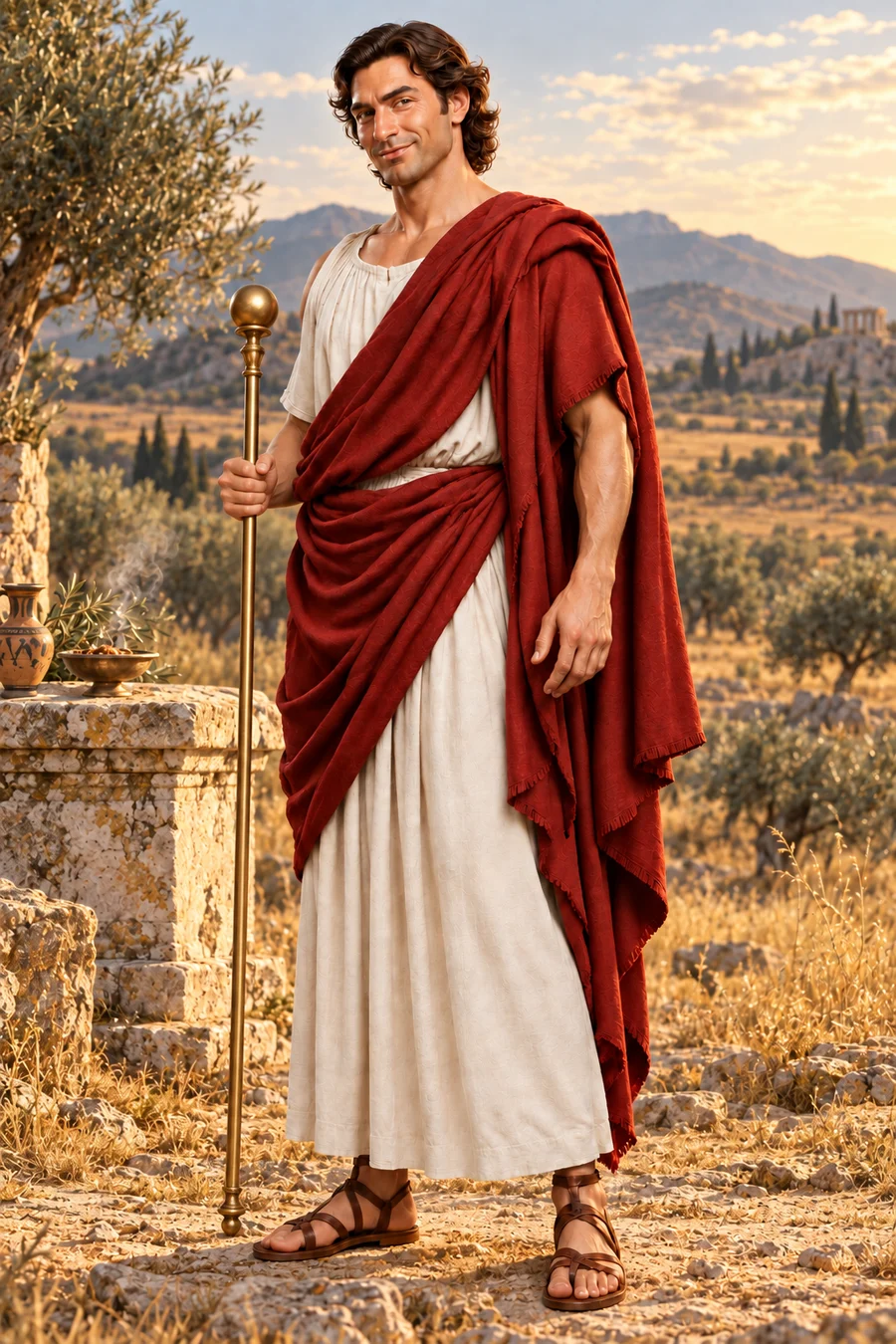
Aegisthus, son of Thyestes and Pelopeia, rose to stand as the ruler of Argos and the possessor of a king's house.1,2,3,4,5,6,7 Endowed with good looks and often seen walking full of joy, he presented a striking contrast to the shameful birth that some accounts emphasized.6,8,9 Though accustomed to woe and exile, which were naught to him, he wore the specific robes of Agamemnon and carried the scepter that had previously belonged to the murdered king.4,10,11 His nature was marked by a cautious vigilance, as he was too wary to allow the sisters of his victim to bear children who might one day harm him.12
The path to his throne began when Clytaemnestra, daughter of Tyndareus, left her husband Agamemnon to sleep with Aegisthus, who became her secret husband and bedfellow in their home.13,14,2 This union was not merely private, for Aegisthus acted as a shield of confidence for Clytaemnestra, and she referred to him as her partner in perils and rule.15,16,4,17 While Menelaus was away from home, Aegisthus plotted an evil deed, inviting Agamemnon to a banquet with the intent to kill him.18,19,20,21 After the banquet was finished, Aegisthus murdered Agamemnon in a bath using a strange net, fetters not made by a smith, and a shamefully fabricated trap.16,2,1,13 He committed this treachery in his own house, an act he undertook despite knowing it would lead to his own death.22,23
Having gained the throne of Mycenae through his guilty love for Clytaemnestra, Aegisthus ruled in the center of Argos and openly reveled in the spoils of the murdered father's labor.16,7,2,5,13 He intended to use the dead king's gold to control the people of Argos, who were obedient to his rule, which he called a bit in the mouth for them.24,19,25 To secure his position, he arranged for Electra to marry a poor peasant who could not father sons, preventing her from bearing an avenger, and kept her at home to avoid family shame.2,21,26,27 Aegisthus also transported a protective bard to a deserted island to leave him to die, while performing numerous burnt sacrifices to the gods and adorning many temples with tapestries and gilding.28,29 Despite these displays of piety, he ignored Hermes's warning to avoid such actions, and he poured libations at the hearth where he had murdered Electra's father.23,10
Aegisthus slept in the bed of Electra's father and inspected sacrificial entrails, specifically the liver, portal vein, and gall-bladder, becoming angry when the liver lacked a lobe and the veins revealed threatening signs.10,30 He was described as false and a murderer in the context of the funeral rites, a label that stuck to him even as he prepared a feast for the Nymphs and cast barley on the altar.31,18,32,33 Orestes and Electra viewed him as an enemy, and Electra saw him as a firmly established foe in her father's house, seeking to inflict great destruction upon him.34,35,36,12 Aegisthus employed a watchman who was promised two talents of gold, and he had a band of his own servants with him, including a servant who rushed in after the commotion of his death.37,32,38 He possessed fields situated by the road, and his estate was a place of both opulence and dread for those who knew the truth of his rise to power.32
In the eighth year of his rule, Aegisthus was killed by Orestes, the son of Agamemnon, in revenge for his father's murder.39,40,41,42 This act of vengeance was praised, and Aegisthus was identified as the person who killed Agamemnon, a deed that marked him as the murderer of Orestes and Electra's father.43,44,42 His corpse was found lying on the ground, and Clytaemnestra expressed deep affection for him upon seeing his body.45,46,39 He removed the cloth covering the face of the shrouded corpse, a final gesture that revealed the end of a reign built on treachery and a shameful birth.47,9
The codex facts behind this entry
Aegisthus is the son of Thyestes, who was the brother of Atreus. Aeschylus, Agamemnon 1577-1616 +3
Appearance
Aegisthus was endowed with good looks and described as being full of joy while walking. Euripides, Electra 907-956 +1
In the myths
Aegisthus invited Agamemnon to a banquet and killed him along with his comrades. Euripides, Electra 157-166 +9 Aegisthus was killed by Orestes in revenge for his father's murder, an act for which Orestes is praised. Apollodorus, Epitome 6.25 +9 Aegisthus murdered Agamemnon in a bath using a strange net, fetters not made by a smith, and a shamefully fabricated trap. Aeschylus, Agamemnon 1577-1616 +8 Aegisthus killed Agamemnon through treachery in his own house, an act he committed despite knowing it would lead to his own death. Euripides, Electra 112-124 +5 Aegisthus killed Agamemnon after the banquet was finished. Apollodorus, Epitome 6.23 +5 Aegisthus plotted an evil deed while Menelaus was away from home. Odyssey 3 ¶21 +1 Aegisthus transported a protective bard to a deserted island to leave him to die. Odyssey 3 ¶23 +1 Aegisthus was preparing a feast for the Nymphs and cast barley on the altar while praying for himself and his wife. Euripides, Electra 596-645 +1 Aegisthus arranged for Electra to marry a poor peasant who could not father sons to prevent her from bearing an avenger. Euripides, Electra 1-49 +1 Aegisthus kept Electra at home and prevented her from going to the gates to avoid family shame. Sophocles, Electra 310-340 +1
Fate
Aegisthus is dead and his corpse is lying on the ground. Euripides, Electra 747-773 +2 Aegisthus was killed by Orestes, the son of Agamemnon, in the eighth year of his rule. Aeschylus, Libation Bearers 875-899 +2