CASSANDRA (prophetess and princess of Troy)
Figure of myth · mythological prophetess and princess of Troy
- Parents
- Priam, Hecuba
- Siblings
- Hector, Paris, Helenus, Polyxena
- Consorts
- Agamemnon, Coroebus, Othryoneus
- Children
- Pelops, Teledamus
- Haunts and cult places
- Amyclae
- In the sources
- 95 ancient passages
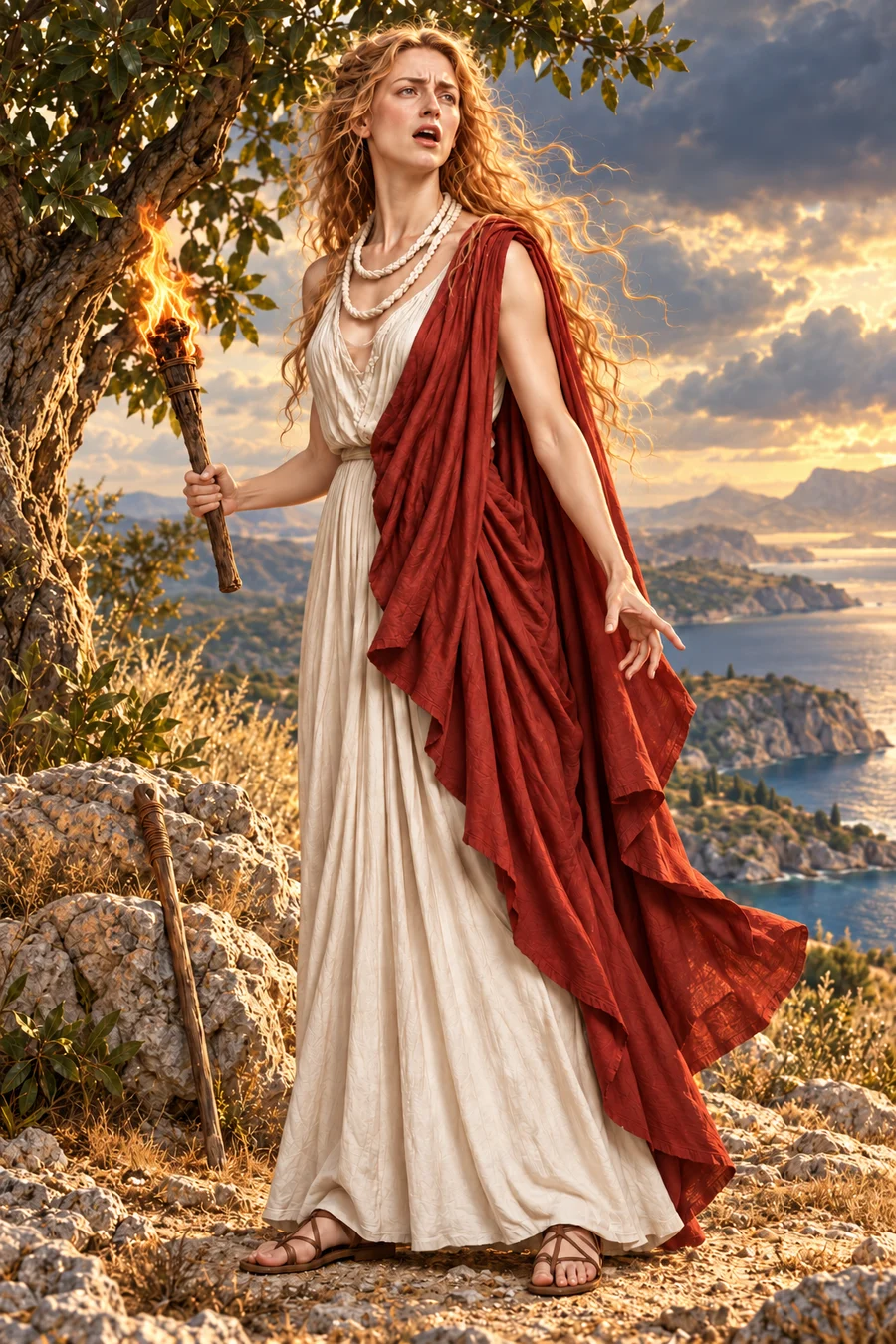
Her golden tresses streamed down snowy shoulders, and her eyes blazed wildly, marking her as a figure of intense and unsettling beauty.1,2 As a virgin princess of Troy, she held a standing that was both royal and sacred, yet her nature was often described as mad and frenzied.3,4,5,6,7,8
The god Apollo, who struggled to win her with ardent love, taught her the art of prophecy and granted her the clear sight to interpret the resistless futures he provided.9,10,1 However, after she consented to the god and then broke her word, Apollo stripped her predictions of persuasive power, and Fate decreed that her truthful prophecies would be ignored by listeners.9,10,11,12,2 This divine affliction left her trembling and possessed by terror, her soul aflame with a knowledge that brought no comfort, only a deep anguish over the impending ruin of her land.13,14,15
She moved through the city with a majestic step, her voice roaring like a wounded lioness as she attempted to alert the Trojans to the disasters that would befall their countrymen.16,2,17,9,18 Though the Argives were amazed by her specific knowledge of their plans, her warnings went unheeded, and she was eventually dragged from the burning city and enslaved.19,2,11,20
King Agamemnon selected her as his personal prize from the captured women, taking her as a rival to his wife and a captive bride to his palace.21,8,20,22,23 In the halls of Mycenae, Cassandra foretold that a woman would kill Agamemnon after bathing him, and she foresaw her own death by a two-edged sword or axe that would sever her neck.24,25,26,5 Her death occurred close to Agamemnon’s fatal wound, as she was killed by Clytemnestra while the king lay dying nearby.27,28,29
Even in her final moments, Cassandra’s prophetic gift remained in her soul, allowing her to see the events of the palace and understand the Greek language well.11,25,13 She removed her sacred garlands and threw them to the winds, while her death was foretold to come by a two-edged sword or axe that would sever her neck.30,26,5 The Amyclaeans later claimed a local figure named Alexandra was actually Cassandra, while the Phrygians referred to her as an inspired maiden.31,32
The codex facts behind this entry
Cassandra is the daughter of Priam and Hecuba. Euripides, Hecuba 658-680 +7 Cassandra is a prophetess and seer appointed by Apollo. Aeschylus, Agamemnon 1202-1241 +4 Cassandra is the virgin daughter of King Priam. Aeneid 2.318 +1
Appearance
Cassandra is described as heavenly-fair, the most beautiful of Priam's children and among her sisters, and as beautiful as golden Aphrodite standing on Pergamus. Iliad 24 ¶50 +3 Cassandra is described as a frenzied maid with golden tresses that streamed down her snowy shoulders, eyes that blazed wildly, and a neck that writhed like a sapling shaken by the wind as she shrieked. Euripides, Iphigenia in Aulis 751-761 +2 Cassandra appeared with loose and disordered hair that had lost its fillet. Aeneid 2.402 +1
Powers
Apollo taught Cassandra the art of prophecy, giving her the ability to clearly interpret the resistless prophecies he provides. Apollodorus 3.12.5 +2 Her ability to predict the future was known to the chorus members. Aeneid 2.195 +2
In the myths
Ajax committed an outrage against Cassandra by dragging her away from the sanctuary of Athena, tearing the image of the goddess from its stand, and knocking it over. Pausanias 1.15.2 +6 Cassandra was killed by Clytemnestra while Agamemnon lay dying nearby. Apollodorus, Epitome 6.23 +3 King Agamemnon selected her as his personal prize from the captured Trojan women. Apollodorus, Epitome 5.23 +2 Odysseus urged the Greeks to stone Ajax for his outrage against Cassandra. Pausanias 10.31.2 +1 Coroebus came to Troy with the intention of marrying Cassandra. Pausanias 10.27.1 +1 Othryoneus sought to marry Cassandra without offering traditional wedding gifts or a dowry. Iliad 13 ¶30 +1 Cassandra suffered deep anguish over the destruction of her homeland, Ilium. Aeschylus, Agamemnon 1242-1294 +1 Cassandra consented to Apollo but broke her word, causing him to strip her prophecy of persuasive power. Aeschylus, Agamemnon 1202-1241 +1 Apollo destroyed Cassandra a second time. Aeschylus, Agamemnon 1080-1084 +1 Cassandra cried out in sorrow and distress while invoking the name of Apollo. Aeschylus, Agamemnon 1072-1075 +1
Worship
She refers to Apollo as her prince of prophecy and invokes Lycean Apollo while experiencing the prophetic fire. Aeschylus, Agamemnon 1242-1294 +1
Fate
Cassandra states that her hour of death has arrived and she was brought there only to die. Aeschylus, Agamemnon 1136-1145 +2 Cassandra foresees her own death by a two-edged sword or axe that will sever her neck. Aeschylus, Agamemnon 1146-1155 +1 Her death occurred close to Agamemnon's fatal wound. Apollodorus, Epitome 6.23 +1