AEACUS (son of Zeus in Greek mythology)
Figure of myth · son of Zeus in Greek mythology
- Parents
- Zeus, Aegina
- Consorts
- Psamathe, Endeïs
- Children
- Peleus, Telamon, Phocus, Alcimache
- Haunts and cult places
- Aegina
- In the sources
- 128 ancient passages
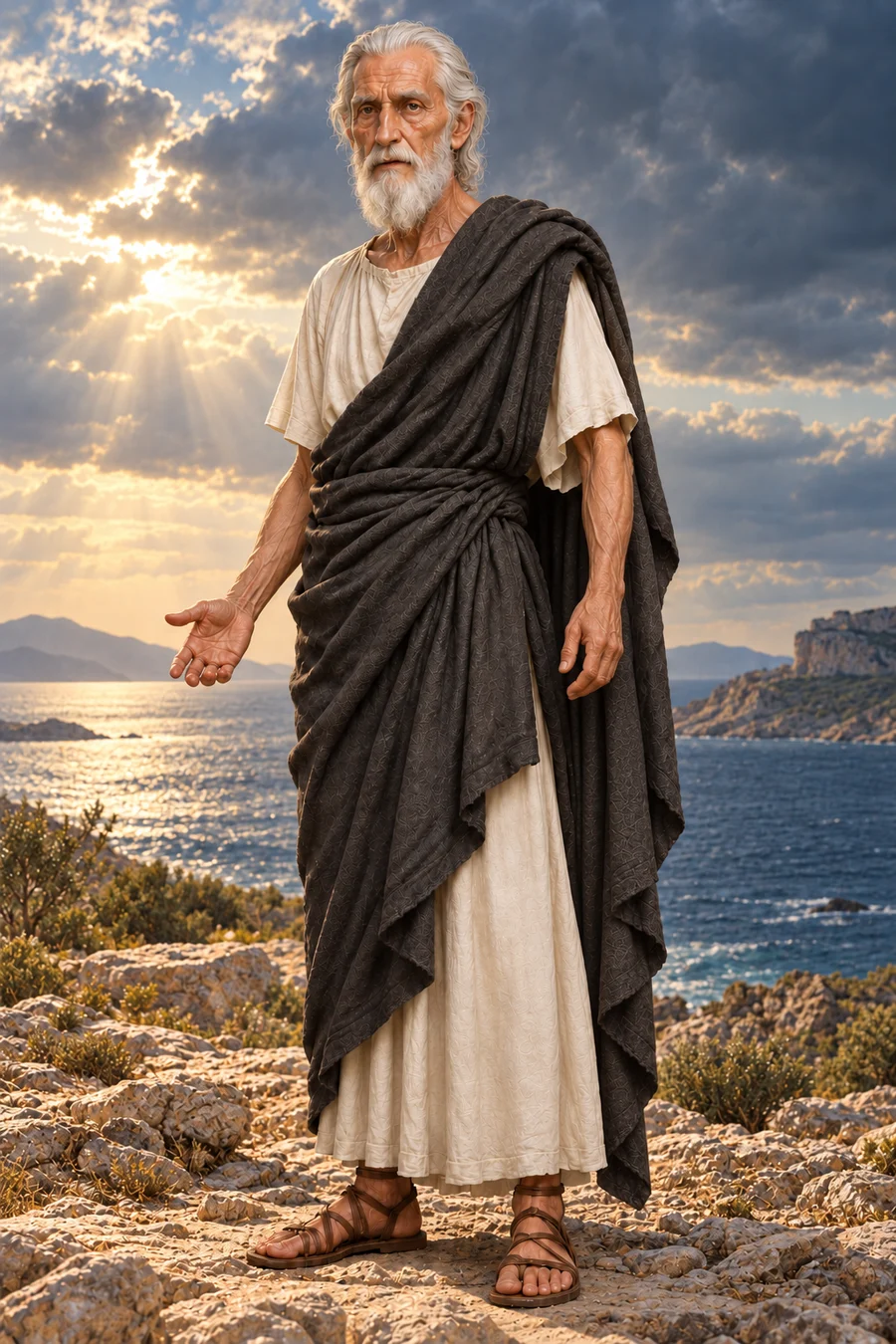
In his later years, he moved slowly due to the infirmities of old age, leaning with his left hand on the handle of his sceptre.1,2,3,4 He was regarded as the most righteous of Hellenes.5
Aeacus was the original inhabitant and the only known king of the island, which he renamed Aegina after his mother, who had previously been known as Oenopia.6,7,8 During a time of famine on the island, Zeus transformed ants into men and women to provide companions for the lonely king.6,9 He chafed at being alone when he reached full youth, a solitude that marked his early days before the divine intervention.10 Aeacus married Endeis, the daughter of Sciron, and together they fathered the two great heroes Peleus and Telamon, with Peleus being the younger brother.6,7 The Nereid Psamathe, daughter of Nereus, also loved him with the help of Aphrodite, and from this union was born their son Phocus.6,3,11
Tragedy struck the family when Peleus and Telamon slew their brother Phocus, leading to their exile from Aegina.12,13 Aeacus intentionally created the dangerous reefs around Aegina to deter pirates and make the island's approach perilous to protect it from sea raids.14 He assigned military leadership to Sciron and brought soldiers who had been recently recruited to defend his realm.15,16 When Minos arrived seeking aid, Aeacus went forth to meet him but refused the request, citing a compact with Cecropia to which he was allied.3 He spoke after Cephalus's eloquence had promoted the cause, maintaining his stance in the diplomatic exchange.4
Aeacus was the only person capable of successfully supplicating Zeus to end a drought, a power for which Greeks from various cities sent envoys to ask him to pray for rain.17,18 Following an oracle's command, he performed a sacrifice to Zeus, the God of all Greeks, on the island of Aegina.19 A shrine dedicated to him stands in the most prominent part of the city of Aegina.14,20
In the realm of the dead, Aeacus holds authority over the silent shades and keeps the keys of Hades.6,21 His duties include preventing the dead from returning to the world of the living and punishing Charon for transporting passengers without payment.22,23 He sits in judgment on the deeds of men, trying trembling culprits for their sins committed on earth and punishing tyrants in the afterlife.24,25 The family, known as the Aeacidae, became the noblest lineage among the enduring Achaeans, producing ancestors for figures like Miltiades and the warrior Ajax.26,27,28,29,30
The codex facts behind this entry
Aeacus is the father of Peleus and Telamon. Aeneid 6.801 +6 Aeacus was the son of Zeus and Aegina. Apollodorus 3.12.6 +2 Aeacus is the ancestor of Achilles. Iliad 11 ¶53 +1
Powers
Aeacus holds authority over the silent shades in the realm of the dead and keeps the keys of Hades. Apollodorus 3.12.6 +1
In the myths
Zeus transformed ants into men and women to provide companions for Aeacus during a famine. Apollodorus 3.12.6 +2 Greeks sent envoys from various cities to Aeacus to ask him to pray to Zeus for rain. Pausanias 2.29.7 +1 Aeacus's sons were exiled from Aegina after slaying their brother Phoeus. Argonautica 1 ¶16 +1 A descendant of Aeacus also slew other Trojans in the river. Bacchylides 13 part 2 +1 Aeacus sits in judgment on the deeds of men, trying trembling culprits for their sins committed on earth and punishing tyrants in the afterlife. Seneca, Hercules Furens act 3 ¶7 +1
Fate
Aeacus is aging and bending under the weight of his declining years. Ovid Met. 9.426-665 +1