INACHUS (river deity and king of the Argolid)
Divine power · river deity and king of the Argolid
- Parents
- Oceanus, Tethys
- Consorts
- Melia, Colaxe, Argeia
- Children
- Argus Panoptes, Phoroneus, Mycene, Aegialeus, Io, Casus, Pegeus, Philodice
- Foes
- Poseidon
- Haunts and cult places
- Argolis, Nile, Larisa, Lerna, Mycenae
- In the sources
- 82 ancient passages
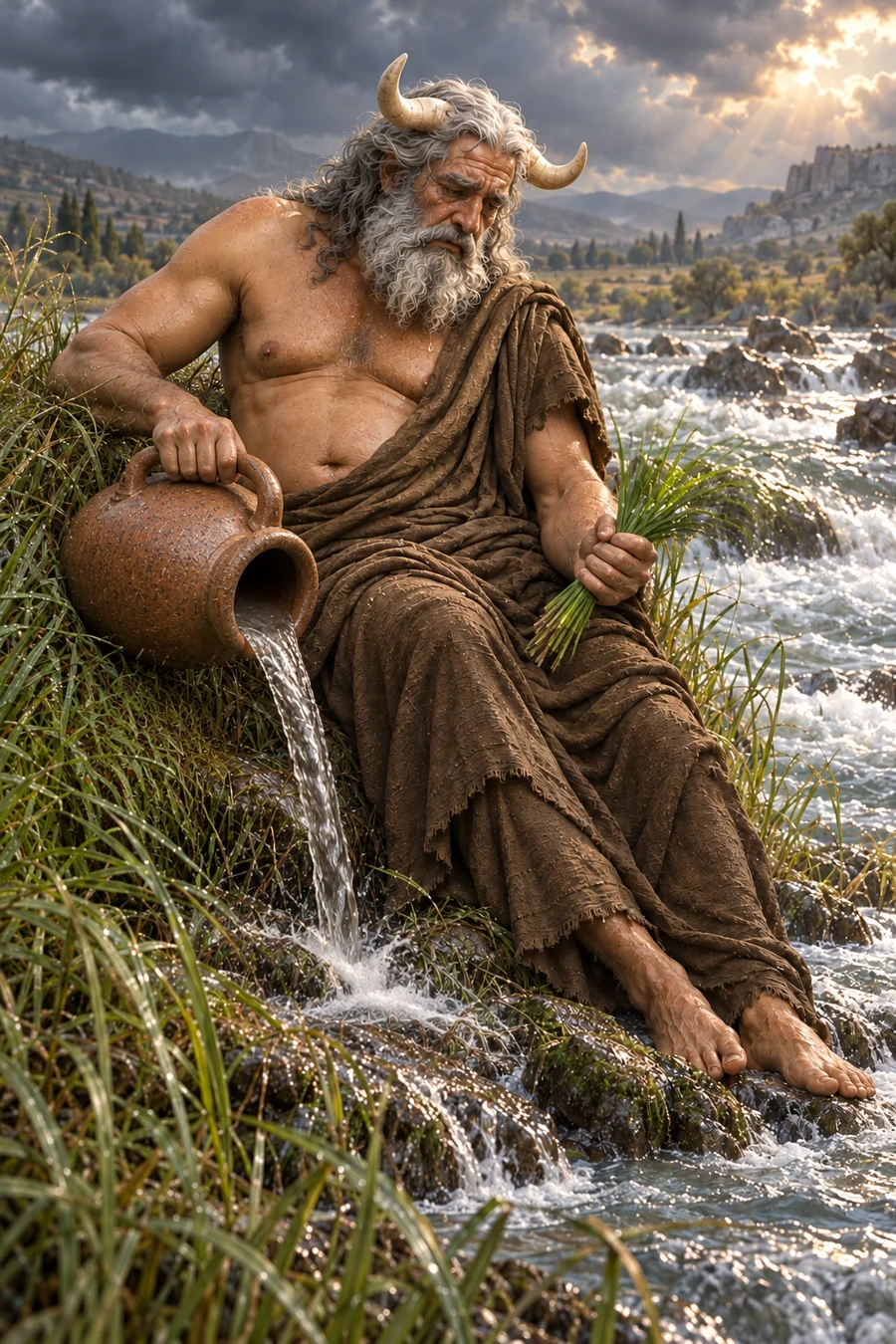
Inachus, son of the deities Ocean and Tethys, was the king of the Argives and the head of a family line.1,2,3,4 He was also identified as a torrent river rather than a human being, and his waters were associated with the land where the Pelasgians dwell.5,6,7 The river Inachus flows through the Argive territory, with its springs located on Mount Artemisius and its streams on the borders of Argolis.8,9,10,11,12,13 It passes underground before emerging in the Argian territory to water the plain, and it mixes its waters with the Achelous.14,15,16
Inachus took Melia, a daughter of Ocean, as his consort, and they had a son named Phoroneus.3 He was the father of Io, the transformed girl, and of Argus, according to Asclepiades.17,18,19,20 The lineage of Inachus extends to the daughters of Danaus, the winged hero who fights the monster, and the descendants of Belus.21,22,4 He was also the ancestor of Turnus and the father of Argia and the noble parents being addressed in the Thebaid.23,24,25 Inachus was the father of a man destined to be Iphigenia's husband, and his sons included the Argive warriors who fled with spear wounds.26,27
Inachus and other rivers judged a land dispute between Poseidon and Hera, ruling that the land belonged to Hera.28,5 In anger at Inachus, Poseidon dried up the springs.28 Inachus performed a sacrifice dedicated to the goddess Hera and named a river after himself during his reign.29 The river is located beyond the sanctuary of Mysian Demeter and flows near the citadel of Larisa in the city of the Argives.30,6 Mount Arachnaeus was named Sapyselaton during the era of Inachus.31
Inachus sent messengers to Pytho and Dodona to seek divine guidance regarding his daughter's dreams.32 He received an oracle commanding him to expel his daughter from their home, a constraint imposed by Zeus who threatened the destruction of his entire race if he refused.32 Inachus sent Cyrnus to search for his missing daughter Io, ordering him not to return without her.1 He had previously searched all lands to find his missing daughter and had prepared a bridal chamber and torches for her wedding.19 Inachus mourned his daughter Io, believing her to be lost and fearing the worst because he could not find her anywhere.33 He hid in his deepest cavern while increasing his waters with tears, and he exclaims in grief, lamenting his inability to die to end his sorrow.33,34,19
He failed to recognize his daughter when she appeared with horns, though he had held grass for her and received kisses from her.19 He wept and clung to his daughter's horns and neck, in a state of extreme wretchedness.19,33 Inachus is described as aged and as the father of the heifer-mother, and he is immortal, with the gate of death shut against him.35,19 The river provides no water except after rain, and its streams are dry in summer, yet it flows on, and no other torrent from Persean land flows more tempestuously than Inachus.5,25,36 The rustics claim that Inachus bellowed loudly, and he turns away from his dishonoured sons.37,27 Orestes offered a lock of hair to Inachus as a return for his care, and the river brings fair water for the Bath of Athena, mixing its waters with gold and flowers.38,39
The codex facts behind this entry
The Inachus is identified as a river flowing through the Argive territory. Lucian, Dialogues of the Sea-Gods 7 ¶1 +4 Inachus is identified as a torrent river rather than a human being. Pausanias 2.15.5 +1 Inachus is identified as the king of the Argives. Diodorus 5.60 +1
Powers
No other torrent from Persean land flows more tempestuously than Inachus. Statius, Thebaid 4.95-120 ¶2
In the myths
Inachus and other rivers judged a land dispute between Poseidon and Hera, ruling that the land belonged to Hera. Apollodorus 2.1.4 +2 He hid in his deepest cavern while increasing his waters with tears. Ovid Met. 1.568-600 +1 The river is said to pass underground before emerging in the Argian territory, where it waters the plain. Strabo 8.6.8 Inachus sent Cyrnus to search for his missing daughter Io, ordering him not to return without her. Diodorus 5.60 Poseidon dried up the springs in anger at Inachus. Apollodorus 2.1.4 He performed a sacrifice dedicated to the goddess Hera. Pausanias 2.15.4 The grandson of Inachus could not tolerate Phaeton's arrogant boasting about his parentage. Ovid Met. 1.724-779 (3) Inachus was absent from the gathering of other rivers at the Peneus's home. Ovid Met. 1.568-600 Orestes offered a lock of hair to Inachus as a return for his care. Aeschylus, Libation Bearers 1-21 Inachus sent messengers to Pytho and Dodona to seek divine guidance regarding his daughter's dreams. Aeschylus, Prometheus Bound 640-686
Fate
Poseidon caused the waters of Inachus to disappear as punishment, leaving him with no water except after rain. Pausanias 2.15.5 He states that death is impossible for him as a god. Ovid Met. 1.601-688 (3) His grief will last for eternal ages because he cannot die. Ovid Met. 1.601-688 (3)