ARGEA (mortal queen in mourning)
Figure of myth · mythological Greek character, daughter of Autesion
- Parents
- Autesion
- Consorts
- Aristodemus
- Children
- Procles, Eurysthenes
- In the sources
- 27 ancient passages
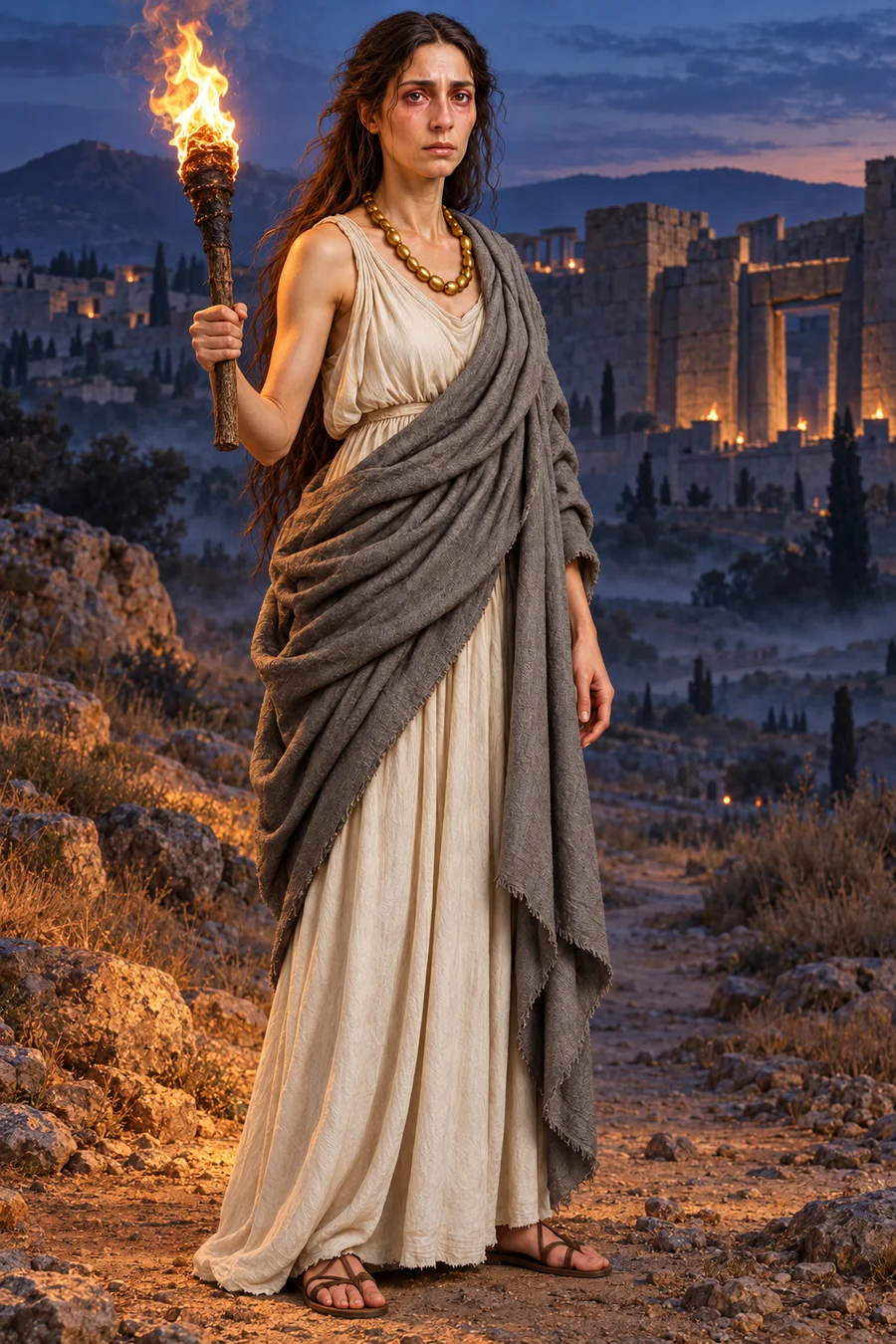
Argea, the illustrious maiden, bore a long face marred by the tearing of her hair and the marks of weeping.1,2 She was the daughter of Autesion and Amphithea, and sister to Deipyle, Aegialeus, Evadne, and Theras.3,4,5,6,7 Accounts differ regarding her parentage; while some sources name Autesion as her father, others identify her as the daughter of Inachus.3,4,8 Her standing was elevated by her possession of a famed necklace, an heirloom that had previously belonged to Harmonia, Semele, and Jocasta, which she wore with pride above her sister's simpler attire.9
Husbands arrived at the king's court to marry her, and she was giving her maidenhood in wedlock.1 She became the wife of Polynices, making her the daughter-in-law of Adrastus.10,11,12,13 She appeared to Polynices as a phantom with torn hair, holding a doleful torch in her hand.12 During these times, she would weep and hide the flame when Polynices questioned her, revealing the depth of her distress.12
Argea’s life was marked by profound loss and desperate journeys through dark forests and dangerous terrain, where her torchlight was frequently swallowed by the night.14 Driven by intense grief and passion, she continued her exhausting journey, even as her companion Menoetes felt ashamed of his slower pace compared to his frail ward.14 She entered a nearby cottage to relight a dying fire and rushed out onto the plain, shuddering as she extended her right hand toward the city walls, begging the city to return her husband's body so she could mourn him.15
The accounts also record Argea as the wife of Aristodemus, with whom she bore the twin sons Procles and Eurysthenes.3,7,4,16 Her spoils were targeted for theft by a wife who wanted to outshine her in stolen finery, while her jealous sister secretly envied her possession of the terrible jewel.17,9 She planned dangerous missions to confront the laws of the impious realm, challenging the gods and the cruel king despite the peril involved.18
Argea mourned at the pyre of her beloved Polyxenes, embracing the same body as Antigone.19 She revealed her identity while holding the corpse, remaining in utter silence at first before speaking while still clasping the body.19 She cast her raiment about her husband's face and her own due to sudden fear.19 Argea recounted the story of her brother to Antigone, stating that he had desired Antigone more than his homeland or mother, and spoke of her constantly during his exile.20 Her final image is that of a woman defined by her intense passion and grief, a figure who endured the horrors of war and the loss of her loved ones with unwavering, if tragic, resolve.14,2
The codex facts behind this entry
In the myths
Argeia gave birth to the twin sons of Aristodemus. Herodotus 6.52.2 +1