TYPHON (deadly monster of Greek mythology)
Monster · deadly monster of Greek mythology
- Parents
- Tartarus, Gaia
- Consorts
- Echidna
- Children
- Hydra, Scylla, sphinx, Cerberus, Colchian Dragon, Ladon, Nemean lion, chimera, Aethon, Crommyonian Sow, Orthrus, Anemoi Thuellai and 1 more
- Foes
- Zeus
- Haunts and cult places
- Cilicia, Cumae, Lydia, Phrygia, Antioch, Hyde
- In the sources
- 43 ancient passages
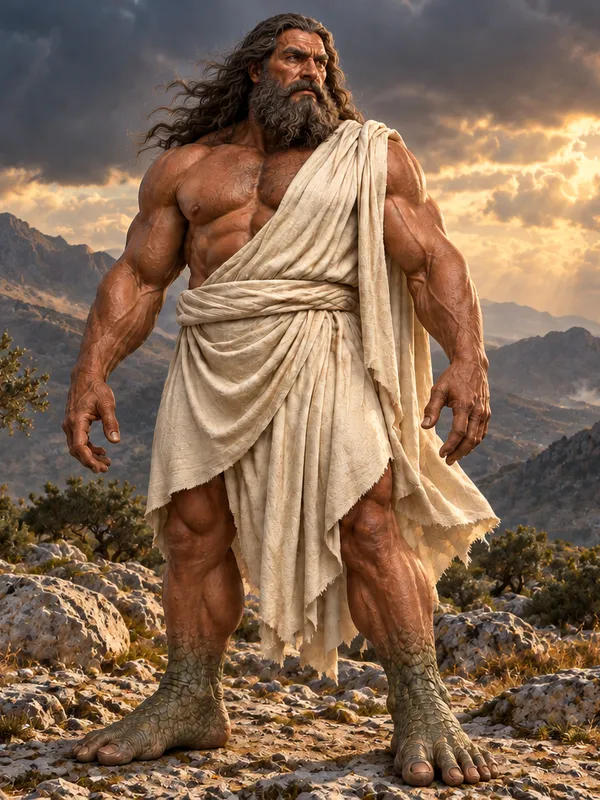
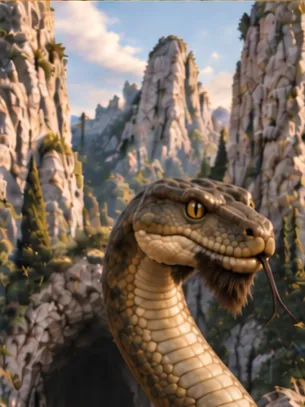
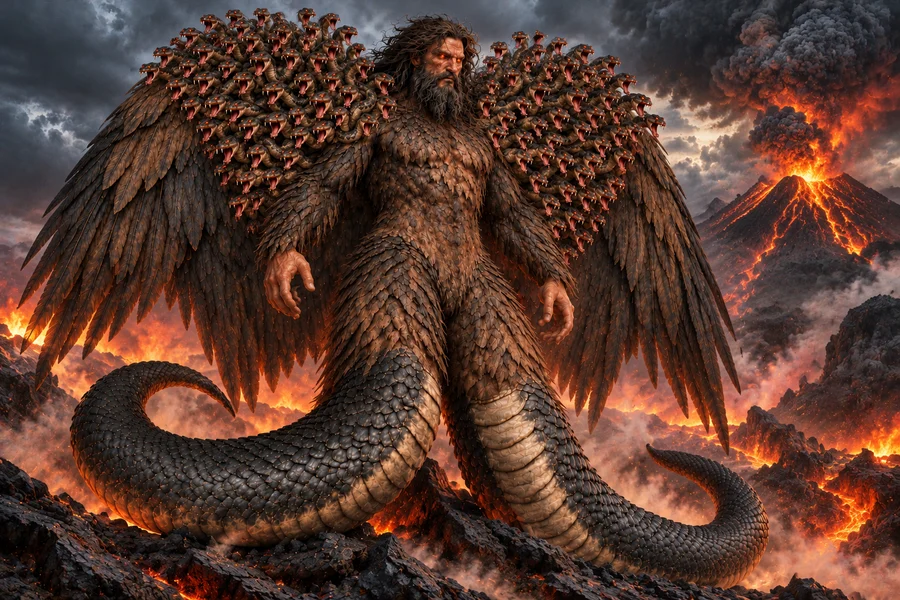
Typhon, a hybrid creature born of Earth and Tartarus, rose as a foe of the gods.1,2,3 His upper body was human-shaped but larger than all mountains, while his lower body consisted of huge coils of vipers.1 One hundred snake heads grew from his shoulders, their horrid jaws flickering with dark tongues.2,4 Fire flashed from under his brows and burned from his heads as he glared, his entire body covered in wings.2,1 His head frequently touched the stars due to his immense height, and he wore cords bound with ninefold serpent coils.1,5
Born in the region of Cilicia, Typhon sought to seize the power of Zeus.4,1 He resisted all the gods while hissing terror from his jaws, his voice a mix of bull bellowing, lion roars, and whelps.4,2 In a fierce battle at Mount Haemus, he heaved whole mountains and hurled burning rocks toward heaven.1 Typhon wrested the sickle from Zeus and cut his sinews, hiding them in a bearskin within the Corycian cave in Cilicia.1 He lifted Zeus on his shoulders and carried him through the sea to Cilicia, setting the she-dragon Delphyne to guard the hidden sinews.1
Zeus struck Typhon with thunderbolts and an adamantine sickle, burning him to ashes and blasting his strength away.4,1,6 The monster fell onto the earth as a maimed wreck, and the dark earth groaned around him as he collapsed.7,2 After being struck, Typhon sought refuge by moving underground, where he now lies beneath the mountain Aetna.8,4,3 Accounts differ on his location; Pindar says he lies under the strait from Cumae to Sicily, where cliffs press on his shaggy breast.3,9
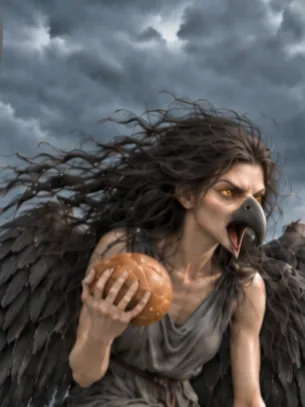
With Echidna, Typhon fathered the Chimera and the Sphinx, and he is also the father of the invulnerable Nemean lion.10,11,12 He is also the father of the two-headed hound Orthus, the hundred-headed dragon that guards the golden apples, and the eagle that devours Prometheus's liver.13,14 Typhoeus is also named as the parent of the boisterous winds, excluding Notus, Boreas, and Zephyr.15 As the deadly ancestor of these creatures, his legacy remains a source of terror.16
Typhon causes flames and water to rush forth when he turns.9 He will eventually spout rivers of fire that devour the fields of Sicily, and sometimes causes small islands with hot springs to rise in the sea.4,9
The codex facts behind this entry
Typhon is a destructive monster with one hundred heads. Aeschylus, Prometheus Bound 343-378 +2 Typhoeus is described as a monstrous being born from Earth in her anger toward Zeus. Argonautica 2 ¶5 Typhon was a hybrid creature born from Earth and Tartarus. Apollodorus 1.6.3
Appearance
His eyes emitted a hideous glare as he attempted to seize Zeus's power. Aeschylus, Prometheus Bound 343-378 He possessed one hundred snake heads growing from his shoulders. The Theogony ll. 820-868 His entire body was covered in wings. Apollodorus 1.6.3 His head frequently touched the stars due to his immense height. Apollodorus 1.6.3 His lower body consisted of huge coils of vipers. Apollodorus 1.6.3 His upper body was human-shaped but larger than all mountains. Apollodorus 1.6.3
Powers
His feet were described as untiring and strong. The Theogony ll. 820-868 His heads produced various loud and terrifying sounds. The Theogony ll. 820-868 Typhoeus is identified as one of the giants capable of threatening the heavens. Seneca, Thyestes act 4 ¶9
In the myths
Zeus struck Typhon with thunderbolts and an adamantine sickle. Aeschylus, Prometheus Bound 343-378 +4 Typhon searched the world to find the son of Osiris and was expected to potentially cast the body of Osiris out of its hiding place. Herodotus 2.156.4 +1 Typhon's hunt caused Leto to hide Apollo on a floating island. Herodotus 2.156.4 Typhon formed the bed of the river while moving through the ground. Strabo 16.2.7 The Kilikian land is said to have originally bred him. Pindar, Pythian 1 ¶3 Pindar claims Typhon once dwelt in caverns located in Cilicia. Strabo 13.4.6 Typhon resisted all the gods while hissing terror from his jaws. Aeschylus, Prometheus Bound 343-378 Typhon will eventually spout rivers of fire that devour the fields of Sicily. Aeschylus, Prometheus Bound 343-378 Typhon carried the wounded Zeus to the Corycian cave in Cilicia. Apollodorus 1.6.3 He set the she-dragon Delphyne to guard the hidden sinews. Apollodorus 1.6.3
Fate
Zeus killed Typhon with a thunderbolt that burned him to ashes and blasted his strength away. Aeschylus, Prometheus Bound 343-378 +2 Typhon fell onto the earth as a maimed wreck after being conquered. Quintus 5 ¶36 +1 Zeus cast him into wide Tartarus in the bitterness of his anger. The Theogony ll. 820-868 Pindar describes Typhon as being pressed upon by Sicily and the surrounding sea. Strabo 13.4.6