NESSUS (centaur in Greek mythology)
Monster · centaur in Greek mythology
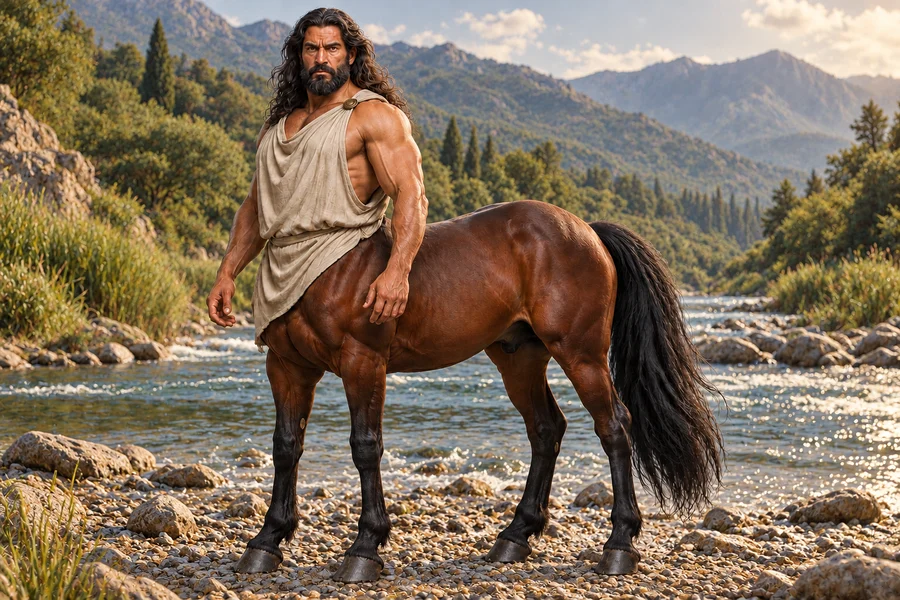
Nessus was a fierce, two-shaped monster with the powers of a horse, strong of limb and black-haired.1,2,3,4 He was the son of the cloud nymph Nephele and Ixion, originating from Melanippion on a mountain-ridge in the region of the mountain Pindus.5,6 Nessus operated a ferry service across the river Evenus, where he was well acquainted with the fords and ferried travelers for payment.7,8,9,10 He claimed the gods gave him the ferry rights due to his righteousness, displaying vain confidence in his feet toward Heracles.8,2
When Heracles and Deianira arrived at the swollen river Evenus, Nessus demanded payment to carry Deianira across.5 He carried Deianira on his back while swimming through the river's waves, having previously carried her on his shoulders when she first left with Heracles.9,5 However, while Heracles was still in the water, Nessus attempted to carry off Deianira against her will, an act of bestial guile.1,2,11,12,4 He also attempted to steal the bow that Heracles had entrusted to him, revealing his false and skilled nature.2,11,12
Heracles took revenge on Nessus at the river Euenus, shooting him with an arrow while the centaur was assaulting Deianira.13,14,2 The centaur was struck while in mid-flight, and black venom from the arrow wound mixed with Nessus's blood as he died.15,2,16 According to one account, Heracles wounded him but did not kill him immediately, and Nessus reportedly escaped to the local country after being wounded.17 Nessus died, and his blood was collected in a vessel, staining the waters of the Evenus with his blood.12,18
Dying, Nessus advised Deianira to mix his blood with his seed to create a love charm for Heracles, instructing her to anoint his shirt with the mixture.8,14,4 He advised keeping the blood-charm in total darkness and had previously instructed Deianira to keep his blood away from fire.4,19 Nessus used deceptive words to prepare murderous goads that tormented the victim, inflicting deceitful torture that smeared the victim's sides with a venomous net.3 He gave his blood-soaked garment to the woman he was abducting, a monstrous gift described as fateful that caused great sorrow.2,20
Deianira used Nessus's blood to smear a tunic for Heracles, which contained the venom of the Lernæan Echidna and was intended as a charm to keep him faithful.21,22 The poison from Nessus's blood caused Heracles to suffer severe burning and agony, and the venom was expected to kill him.22,16 Nessus requited his own death through the suffering of Heracles, having conceived a deadly plot against him and attempted to remove Deianira's hated rival.23,11 His passion for the maiden ultimately proved fatal to him, and his body rotted without burial after he died.1,17 A monument to Nessus is located on the hill Taphiassus, and the water flowing from his burial site is said to smell foul and contain blood.24
The codex facts behind this entry
Nessus is described as a fierce, two-shaped monster with the powers of a horse. Ovid Met. 9.101-272 +2 Nessus served as a ferryman on the river Evenus, charging people for passage. Sophocles, Trachiniae 531-587 +1
Appearance
Nessus is described as strong of limb and black-haired. Ovid Met. 9.101-272 +1
Powers
Nessus's blood was claimed to possess the powers of love and could restore wavering love. Ovid, Heroides 9.147 +1 He claimed the gods gave him the ferry rights due to his righteousness. Apollodorus 2.7.6 His blood caused a cloth to burst into flames when exposed to sunlight. Seneca, Hercules Oetaeus act 3 ¶1
In the myths
Dying, Nessus advised Deianira to mix his blood with his seed to create a love charm for Heracles. Apollodorus 2.7.6 +6 Heracles shot Nessus with an arrow while the centaur was assaulting Deianira. Diodorus 4.36 +3 Nessus attempted to carry off Deianira against her will while Heracles was crossing the river Euenus. Ovid Met. 9.101-272 +2 Nessus instructed Deïaneira to anoint Heracles' shirt with the mixture as a love charm. Diodorus 4.36 +1 Nessus used deceptive words to prepare murderous goads that tormented the victim. Sophocles, Trachiniae 831-840 Nessus inflicted deceitful torture that smeared the victim's sides with a venomous net. Sophocles, Trachiniae 831-840 He gave his blood-soaked garment to the woman he was abducting. Ovid Met. 9.101-272 (2) He reportedly escaped to the local country after being wounded. Pausanias 10.38.2 His decaying corpse caused a foul stench in the local atmosphere. Pausanias 10.38.2 The centaur was struck while in mid-flight. Quintus 6 ¶21
Fate
Nessus was killed by an arrow shot by Heracles in anger over his assault on Deianira. Apollodorus 2.7.6 +7 Black venom from the arrow wound mixed with Nessus's blood as he died. Ovid Met. 9.101-272 (2) +1 The venom from Nessus's wound is expected to kill Heracles. Sophocles, Trachiniae 705-722 He vowed he would not die without taking revenge. Ovid Met. 9.101-272 (2)