GLAUCUS (semi-divine sea-dweller)
Power of the sea · semi-divine sea-dweller in Greek mythology
- Known as
- Pontius
- Parents
- Polybus of Sicyon, Anthedon, Poseidon, Euboea, naiad, Alcyone
- Children
- Deiphobe
- Allies
- Poseidon
- Foes
- Circe
- Haunts and cult places
- Euboea, Delos
- In the sources
- 36 ancient passages
Before his divine status, he was a fisherman, sailor, and excellent diver from the grassy shore of Anthedon, where a leap named for him marks the seaside near Euboea.1,2,3,4
His transformation began when he hunted a hare near the mountain Orea in Aetolia and witnessed it recover after eating a specific type of grass.5 Glaucus tasted the herb and then drowned in the sea, or threw himself in during a storm by Zeus's will, or followed Melicert, depending on the account.5 The agency of herbs transformed him into a newly created resident of the deep ocean who ploughs the swelling waves.5,6,7,8 He began to behold his own fish-tail, and his limbs were devoured by four mares, marking his final departure from human form.3,9
Overcome by passion for Scylla, he pursued her on the Italian shores opposite Messenian walls, speaking to her to stop her fleeing.7,8 He made promises, entreaties, and caresses, swearing his love would never change while she lived, but was rejected by the maid.8,10,5 Glaucus grieved for Scylla and asked Circe to use incantations or herbs to make her share in his flame of passion.11,8 He fled from a proposed alliance with Circe and swam through the Etrurian seas using his huge hands, eventually visiting Scylla's cave bearing a mazy shell and an unfledged bird.11,8,5 Other accounts claim he was in love with Hydna, daughter of Scyllus, or enamoured of Melicert, illustrating the conflicting narratives of his romantic pursuits.5
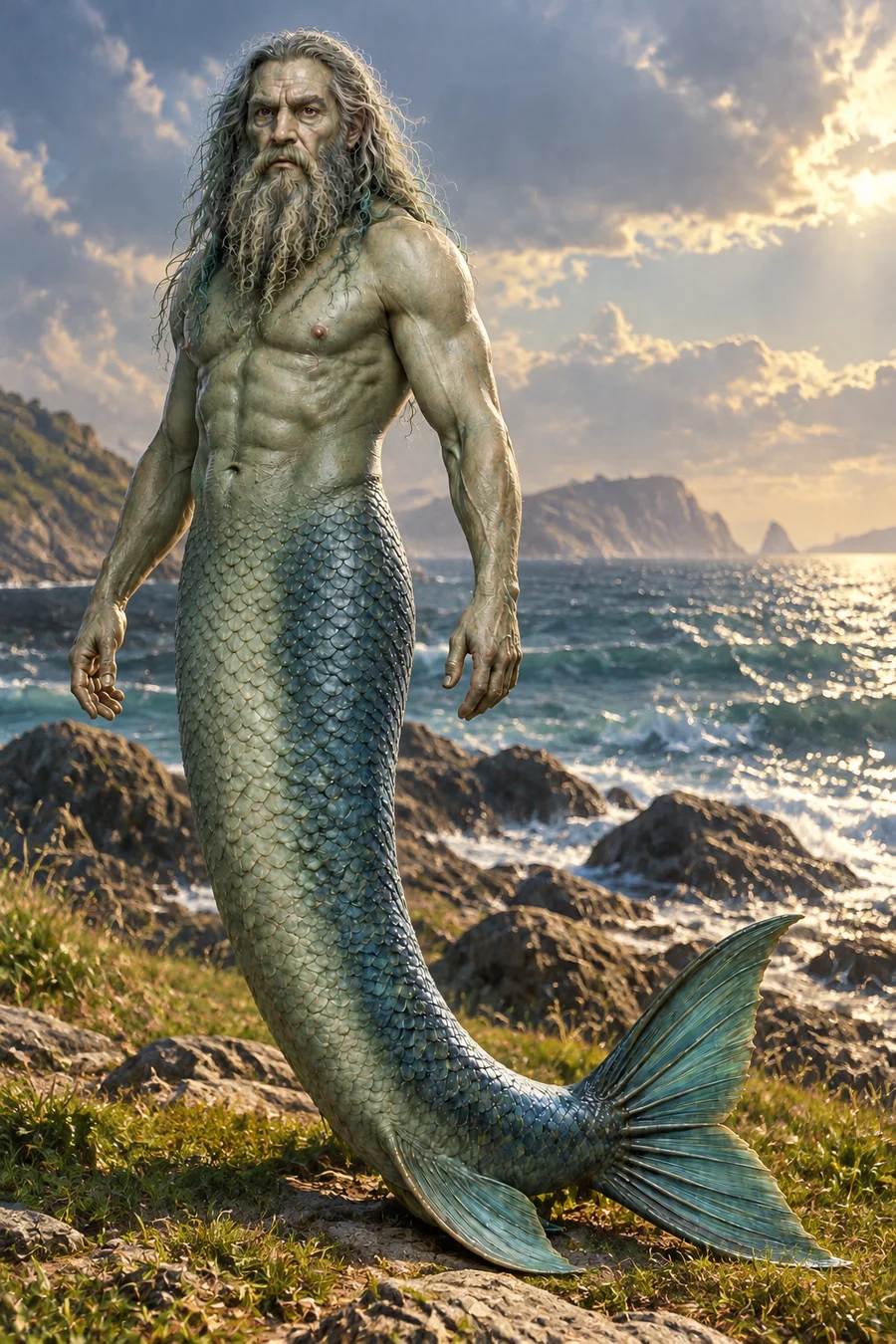
As a seer, he emerged from the depths of the sea and stationed himself in full view to address the crew, raising his shaggy head and chest from the water up to his waist.12,13 He seized the ship's keel with his sturdy hand and cried out to the eager crew, fulfilling his role as a wise interpreter of Nereus.12,13 He foretells the future to men, and seafaring people frequently share stories about his prophetic abilities, with Apollo himself learning divination from him according to Nicander.2,5 He brought news of Agamemnon's death to Menelaus from the waves, acting as a truthful messenger.13,12
In battle, he charged straight at the Danaans to attack their ships, helping array his companions in ox-hide shields before the assault.14 Glaucus sailed to Asia and colonized a desert island near Caria, naming it Syme after his wife, and was seen by Jason alone after becoming a sea deity.1 He trails behind Poseidon's chariot as part of his retinue and is cited as an example of giving a large reward for a small offering.15,16 His fable is located at the fountain Potniae and in the territory of Anthedon, where he plunges beneath the waters from the grassy shore.17,18,3
The codex facts behind this entry
He is identified as a truthful god and a wise seer and interpreter of Nereus. Argonautica 1 ¶121 +1 Glaucus is described as a newly created resident of the deep ocean who ploughs the swelling waves. Ovid Met. 13.898-968 +1 Glaucus was originally a fisherman before becoming a sea deity. Athenaeus 7.47 +1
Appearance
He raised his shaggy head and chest from the water up to his waist. Argonautica 1 ¶121 Glaucus had a sea-green face and hair before plunging. Statius, Thebaid 7.282-308 ¶3 He is described as belonging to a hoary band of sea creatures. Aeneid 5.779
Powers
He possesses the ability to predict the future for humans. Pausanias 9.22.7
In the myths
He charged straight at the Danaans to attack their ships. Iliad 12 ¶5 He brought news of Agamemnon's death to Menelaus from the waves. Euripides, Orestes 356-384 Seafaring people frequently share stories about his prophetic abilities. Pausanias 9.22.7 He asked Circe to use incantations or herbs to make Scylla share in his flame of passion. Ovid Met. 14.1-74 Glaucus fled from a proposed alliance with Circe. Ovid Met. 14.1-74 (5) He cried out to the eager crew of the ship. Argonautica 1 ¶121 He helped array his companions in ox-hide shields before charging. Iliad 12 ¶5 He seized the ship's keel with his sturdy hand. Argonautica 1 ¶121 He swam through the Etrurian seas using his huge hands. Ovid Met. 14.1-74 He was transformed by the agency of herbs. Ovid Met. 14.1-74
Worship
Sailors who reach shore safely pay their vows to him. Georgics 1.424
Fate
Glaucus was transformed into a sea god after eating a specific type of grass. Athenaeus 7.48 +4 His body was recently changed into a sea-dweller form near Anthedon. Ovid Met. 13.898-968 He was torn to pieces near the city by mares from Potniae. Strabo 9.2.24 Glaucus was killed and eaten by mares inspired by Aphrodite. Georgics 3.242