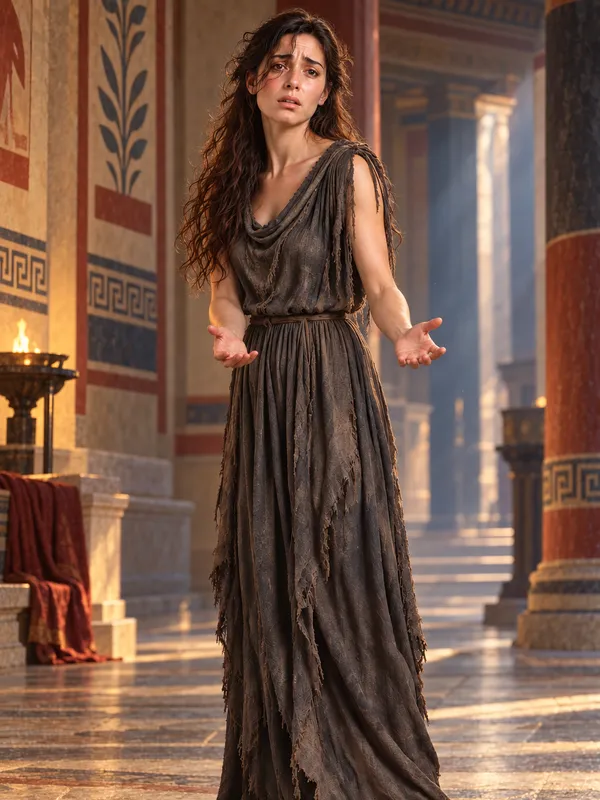
DIRCE (daughter of Ismenus)
Figure of myth · daughter of Ismenus in Greek mythology

Dirce, wife of the king Lycus and daughter of the river god Acheloüs, is a fountain, spring, or stream located in the fertile plain before the seven-gated city of Thebes, where Cadmus settled.1,2,3,4,5 Her standing was that of a venerable and happy virgin, though she was also known as the Ismenian woman who became a fugitive guest in times of trouble.4,6 The waters associated with her name were considered the most nourishing of all streams, flowing near the walled gates of Kadmos and watering the grassy fields located before the river Ismenus.5,7,8,9 Accounts differ regarding her lineage, with some traditions naming Helios or Ismenus as her father, while others identify her as the daughter of Acheloüs.4
In the days of her rule, Dirce imprisoned Antiope and mistreated her with great disrespect.1,3 Antiope's children, Zethus and Amphion, killed Dirce by tying her to a bull as a result of her mistreatment.1,3 Her dead body was finally thrown into a spring, linking her physical end to the water source that bore her name.1,7
The water source named after her death became a holy spring, with the Muses said to have caused the water to spring from the earth.1,7 This stream was described as lovely and green, nurturing the deep-seeded fields and the heroes Heracles and Iphikles.9,10 The children of Poseidon and Tethys were said to pour forth the water of Dirce, connecting the local stream to the broader divine family of the sea.5 A river in the area is named after her, and the water source is associated with the city where Polyneices was born.3,11
Dirce’s character was marked by a sudden frenzy that once caused her to scatter sacred baskets and run down from the Ogygian heights in a state of madness.12 During this episode, she waved a triple pine-torch fiercely while her eyes were bloodshot, filling the alarmed city with wild and distracted cries.12 She was stained with blood during these events, and the river Dirce flowed with blood on two separate occasions.12,13 Though she trembled at the sound of trumpets before the Attic warriors began marching, she was said to bring war with her and leave it to her children.14,6
In the face of Dionysus, Dirce rejected the god and fled from his worshipper and his garland-bearing company.4 She was warned that her joys would be brief due to her impious slaughter, and predicted to return foully to the impious arms of her mother.6 The chorus calls upon her to join in dancing and hymns.15 The winged creature captured young men from the areas associated with Dirce, and Dionysus was located at the fountains associated with her name.16,17 Her legacy remained that of a mother to one of the heroes who rose from his couch, a figure whose rough pastures were claimed as a domain by the speaker.18,19
The codex facts behind this entry
In the myths
Dirce imprisoned Antiope and mistreated her with disrespect. Apollodorus 3.5.5 +1
Fate
Antiope's children, Zethus and Amphion, killed Dirce by tying her to a bull as a result of her mistreatment. Apollodorus 3.5.5 +1