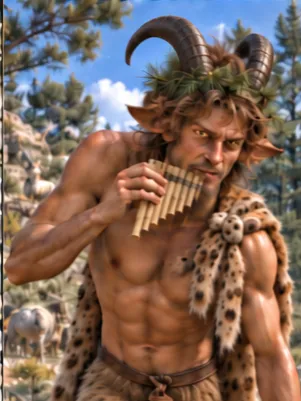
SATYR (goat-legged woodland spirit)
Divine power · goat-like male companions of Pan and Dionysus, in Greek mythology

- Symbols and gear
- cothon, pipes
- In the sources
- 29 ancient passages
The satyr known as Anapauomenos was described as having a much fiercer nature.1,2 It appeared as an animal with human-like facial features, though it was bald and could move either on four feet or walk upright.3,4 This entity possessed extraordinary swiftness and consumed a large amount of food in a short time.3,5
In the myths, Zeus assumed the shape of a Satyr to impregnate Antiope.6 Later, a Satyr was defeated in a flute contest by the son of Leto.7 The son of Leto punished the Satyr for his defeat by stripping his skin from his body.7 This act left him as one wound, with his internal organs, including bowels and lungs, visible and exposed.7 Fauns, wood deities, Satyrs, Olympus, and Nymphs lamented the Satyr's suffering.7 The hanging Satyr brought fame to the place called Celaenae.8
Other Satyrs are identified as the brothers of the punished Satyr.7 In one story, a satyr wronged the Arcadians by stealing their cattle.9 Argus killed the satyr who had robbed the Arcadians.9 In another tale, a sleeping satyr was struck by a dart thrown by Amymone while she searched for water.10 The satyr fled when Poseidon appeared on the scene.10 A small satyr touched the Maiden's breast in a separate incident.11
The Satyr loved only Lyde, rejecting the feelings of Echo.12 The Satyr was scorned in turn as part of a cycle of unrequited love.12 A satyr character in a Sophocles play declared he would leap upon Heracles if he caught fire.13
During processions, one hundred and twenty Satyrs wore complete silver or brass armour.14 Satyrs rode on asses that were part of five troops in the procession.14 The Satyrs riding the asses all wore crowns.14 One satyr held a striped cothon with one handle in his right hand.4 Another satyr held a pair of pipes in his hand.1 A satyr was shown holding a goblet in its hand.15 The satyr sat on the left hand of Dionysus.4 The Satyr crew played flutes, pipes, drums, and cymbals during their nighttime revelry.16 They were reported to engage in gambols on the mountain after dark.16 The satyr was described as being rich in slaves and well housed.17 He held a goat's horn made of gold in his right hand, appearing to blow signals.14
The codex facts behind this entry
The satyr is known by the name Anapauomenos. Pliny, Nat. Hist. 35.36 ¶25 It is described as an animal with human-like facial features. Pliny, Nat. Hist. 7.2 ¶10
Powers
The creature possesses extraordinary swiftness. Pliny, Nat. Hist. 7.2 ¶10
In the myths
Praxiteles created a marble statue of the Satyr, which he was very proud of and claimed his labor was wasted if the flames had caught it. Pausanias 1.20.1 +2 Zeus assumed the shape of a Satyr to impregnate Antiope. Ovid Met. 6.1-145 (5) The Satyr was defeated in a flute contest by the son of Leto. Ovid Met. 6.382-411 Fauns, wood deities, Satyrs, Olympus, and Nymphs lamented the Satyr's suffering. Ovid Met. 6.382-411 A satyr character in a Sophocles play declares he will leap upon Heracles if he catches fire. Athenaeus 1.42 A satyr wronged the Arcadians by stealing their cattle. Apollodorus 2.1.2 Argus killed the satyr who had robbed the Arcadians. Apollodorus 2.1.2 A small satyr touched the Maiden's breast. Theocritus, Idyl 26 ¶5 A sleeping satyr was struck by a dart thrown by Amymone while she searched for water. Apollodorus 2.1.4 Myron of Eleutheræ created a statue depicting a Satyr admiring a flute. Pliny, Nat. Hist. 34.19 ¶5
Fate
The son of Leto punished the Satyr for his defeat in the contest. Ovid Met. 6.382-411 The Satyr's skin was stripped from his body, leaving him as one wound with his internal organs, including bowels and lungs, visible and exposed. Ovid Met. 6.382-411 The satyr fled when Poseidon appeared on the scene. Apollodorus 2.1.4