PHRIXUS (mortal son of Athamas)
Figure of myth · son of Athamas in Greek mythology
- Parents
- Athamas, Nephele
- Siblings
- Helle
- Consorts
- Chalciope
- Children
- Argus, Melas, Phrontis, Cytissorus, Presbon, Cylindros, Demoleon
- In the sources
- 54 ancient passages
Phrixus, son of Athamas and Nephele, was a Minyan and Aeolid figure of the lineage of Aeolus, described as a lusty youth capable of enduring a great flight.1,2,3 He was known for his gentle and pious nature, surpassing all other strangers in his fear of the gods and his mild temperament.4
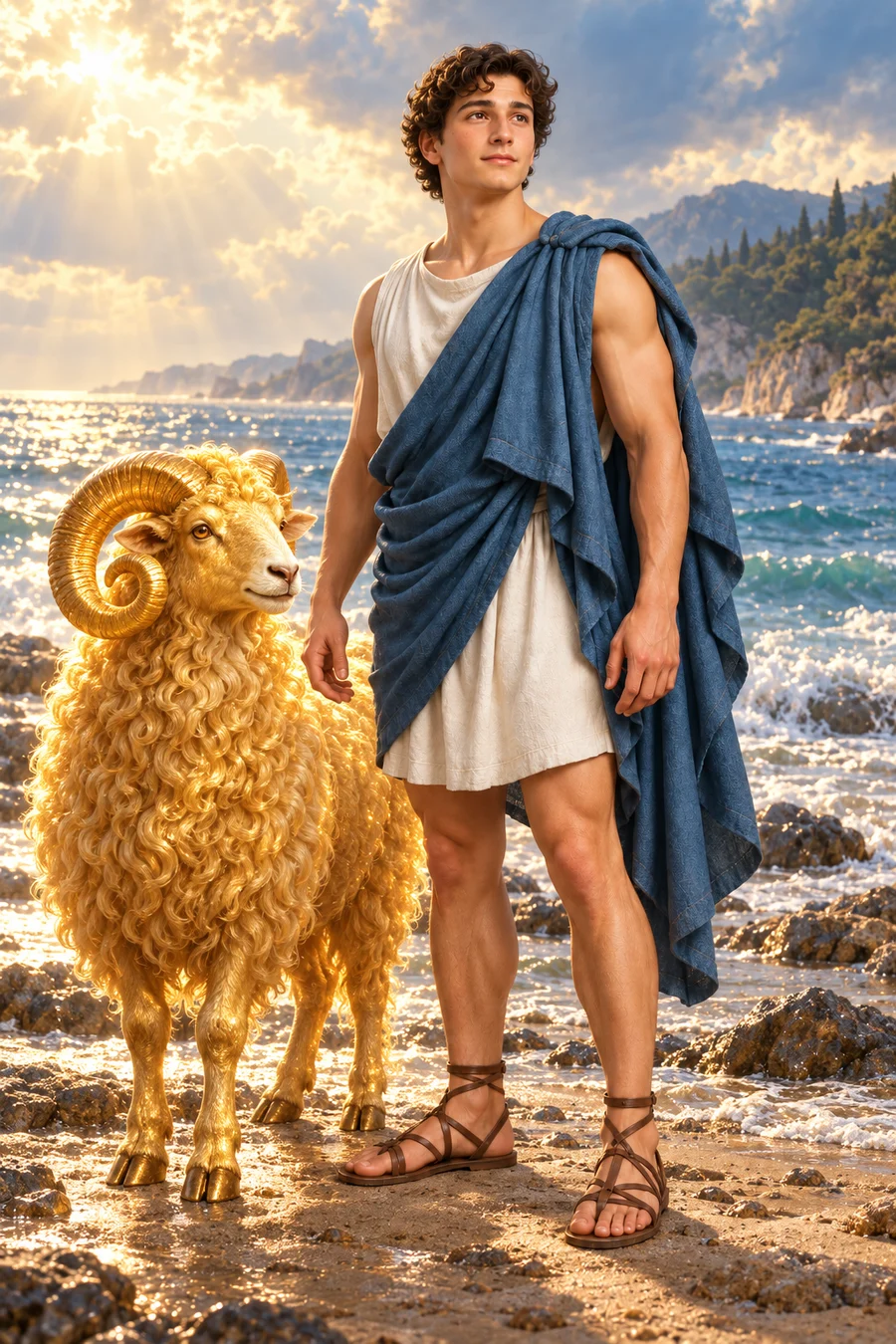
Trouble arose in his father's house when Ino plotted to cause the death of Phrixus and his sister Helle, and Athamas conspired to offer Phrixus as a sacrifice at Mount Laphystius.1,5,6,7,8 Phrixus and Helle rode the golden ram across land and sea from Europe to Asia, fleeing the schemes of their stepmother and escaping a destined sacrifice.9,3,1,10,6,11 During the journey, Phrixus appeared to listen to the ram as if it were speaking, while his mother suffered sorrow over his flight.2,10,12
Helle fell into the sea during the crossing, but Phrixus survived and continued to the region of Colchis, where he arrived as a fugitive.3,13,9,14,15,16 King Aeetes welcomed the young exile and gave him his daughter Chalciope as a wife, with the couple marrying without any wedding gifts being exchanged.1,17,6 Phrixus sacrificed the ram to Zeus in Colchis, cutting out the thighs following Greek custom and watching them burn, an act commanded by an oracle.9,16,17 He hung the shining fleece in the temple of Ares as a dedication, though some accounts claim his attendant Crius was sacrificed and flayed instead of the ram.18,9
Phrixus established an altar to Zeus near the spot where the ram first rested and founded the temple of Leucothea in the Moschic territory.19,20 He lived an aged life in the home of Aeetes, becoming a father to Argus, Phrontis, Melas, Cytissorus, and Presbon.21,17,1,22,23 Other accounts state that Phrixus returned from Colchis, while others claim his son Presbon made the journey home instead.24
The sons of Phrixus later sailed from Colchis toward Orchomenus to retrieve their father's boundless wealth, and they were driven by a storm to an island near the Mossynoeci.25 These descendants forcibly gave Hypsipyle to the strangers to be carried off, and Medea fled from her father's tyranny alongside them.26,27 The golden fleece associated with Phrixus was eventually brought back by Jason, and the fables concerning his expedition provide early evidence of the region's ancient fame.28,29 Traces of the expedition remain in places like Sinope and the Hellespont, including a place called Phrixium midway between Colchis and Iberia.14
The codex facts behind this entry
Phrixus is the son of Athamas and Nephele, a Minyan and Aeolid figure from the lineage of Aeolus. Apollodorus 1.9.1 +7
In the myths
Phrixus fled from Greece with his sister Helle to escape his stepmother's plots by riding on the back of the golden ram. Diodorus 4.47 +5 Poseidon blinded Phineus because he revealed the route to Phrixus. Apollodorus 1.9.21 +2 Phrixus rode a golden ram created by Hermes to reach the city of Aeetes, where he sacrificed it to Zeus at the command of Hermes. Apollodorus 1.9.1 +2 Phrixus was carried across the sea by a divine ram, appearing to listen to it as if it were speaking. Argonautica 1 ¶91 +1 Ino plotted to cause the death of Phrixus and his sister Helle. Apollodorus 1.9.1 +1 Phrixus undertook an expedition to the region of Colchis and arrived there. Diodorus 4.47 +1 He sacrificed the ram in Colchis as commanded by an oracle, cutting out the thighs following Greek custom and watching them burn. Diodorus 4.47 +1 He traveled from Europe to Asia on the back of a golden-fleeced ram, crossing land and sea. Apollodorus 1.9.1 +1
Fate
Phrixus survived the death of Helle while riding the ram. Argonautica 1 ¶41 +1